Biodiversity-ecosystem functioning research has largely focussed on effects of diversity on smaller (α-diversity) or larger scale (γ-diversity). The role of the dissimilarity of communities (β-diversity), however, is often not considered. In my master thesis project with Fons van der Plas, I used Lotka-Volterra models to simulate metacommunities to test how β-diversity and environmental heterogeneity affect biomass production. Some of the results are published in TREE (see here: https://doi.org/10.1016/j.tree.2023.01.008).

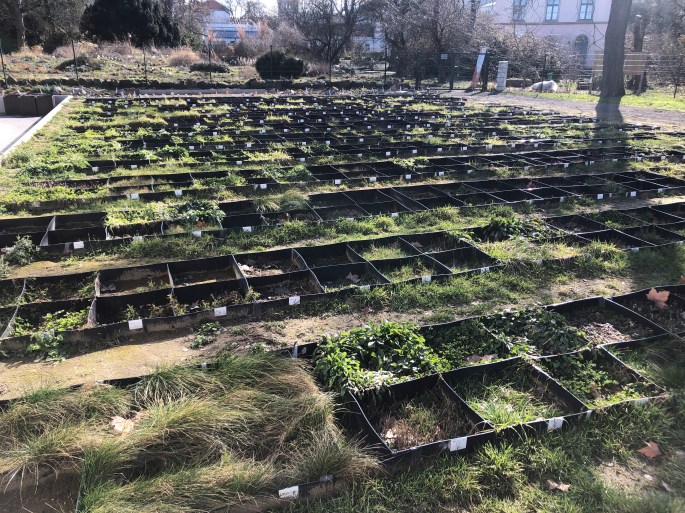
In addition, we started what we call the α-β- diversity experiment. We aimed to investigate the effects and mechanisms of β-diversity on productivity. Using common grassland plant species, we experimentally manipulated initial α– and β-diversity in 50x50cm plots, with half of the plots being filled with nutrient-rich and the other half with nutrient-poor soil. By allowing species to ‘migrate’ from one subplot to another (and hence potentially immigrate into plots that match their abiotic preferences better), we could evaluate the role of species sorting as a mechanism of β-diversity on ecosystem functioning.
A manuscript on this is in progress, so stay tuned for further updates on this!
 Justus Hennecke